Key Takeaways
- The Montessori method encourages children to take ownership of their own learning journey.
- Mixed-age classrooms foster a unique peer-teaching environment that builds social maturity.
- Practical life skills taught in these centres lead to greater independence at home and school.
Introduction
When you first walk into a childcare centre in Singapore that follows a Montessori philosophy, you might be struck by how quiet it is. It isn’t the eerie silence of children being told to be still, but rather the focused hum of young minds at work. You see children as young as three carefully carrying trays, slicing bananas, or arranging coloured beads with intense concentration. It’s quite different from the high-energy, often chaotic atmosphere of a traditional playroom. This intentionality is the hallmark of Montessori childcare learning. It’s an approach that doesn’t just look at the child as they are today, but as the adult they will one day become.
The Power of Self-Directed Learning
In many educational settings, the teacher is the “sage on the stage,” directing every move the children make. However, in a Montessori-based centre, the child is the protagonist. They are given the freedom to choose their work from a range of developmentally appropriate options. This might sound like a recipe for mayhem, but it is actually deeply disciplined. Because the children choose what they do, they are naturally more invested in the task. If a child wants to spend an hour learning how to button a shirt or count to a thousand using golden beads, they are allowed that time.
This freedom builds a sense of agency that is rare in traditional schooling. Imagine being four years old and being trusted to manage your own time! It instils a profound sense of self-worth. They learn that their interests matter and that they have the capability to see a task through to the end. You know that spark of pride when a child shouts, “I did it myself!”? Montessori education seeks to keep that spark alive every single day. By removing the constant “no” and “don’t touch” of typical environments, we allow their curiosity to lead the way.
Developing Practical Life Skills
One of the most unique aspects of this method is the emphasis on “Practical Life” exercises. These are everyday tasks like pouring water, sweeping the floor, or polishing a mirror. To an adult, these are chores; to a child, they are fascinating opportunities to master their environment. A childcare centre that integrates these activities is helping children develop incredible fine motor control and hand-eye coordination. But more than that, it teaches them that they are a contributing member of their community.
These skills translate directly to life at home. A Montessori-trained child is often the one who wants to help set the table or put away their own laundry. It fosters a sense of responsibility and independence that serves them well into their teenage years and beyond. They don’t wait for someone else to fix a problem; they look for a way to do it themselves. Honestly, seeing a preschooler handle a real glass pitcher with care and precision is a great reminder of how much children can achieve when we stop underestimating them. It is about building a “can-do” attitude from the very beginning.
The Social Benefit of Mixed-Age Groups
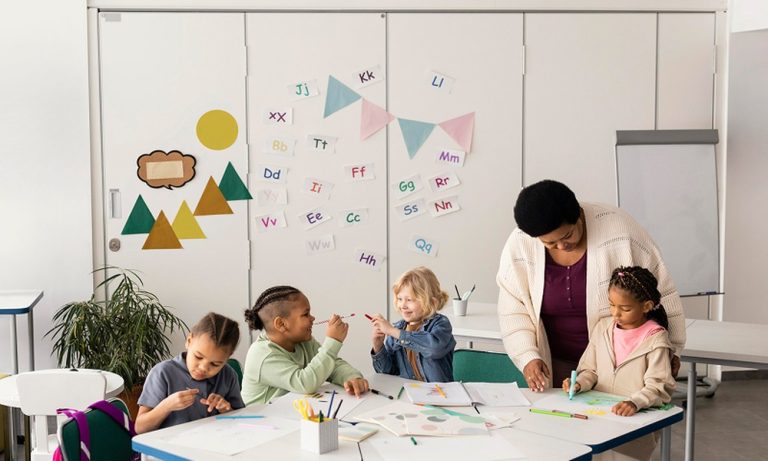
In a typical Montessori childcare setting, you won’t find children grouped strictly by their birth year. Instead, you’ll see “vertical grouping,” where children of different ages work together. This mimics real life much better than age-segregated classrooms. The older children naturally step into leadership roles, helping the younger ones with a difficult puzzle or showing them how to wash their hands. This “peer teaching” is incredibly effective. A three-year-old is often much more interested in what a five-year-old is doing than what an adult is saying!
For the older children, this reinforces their own knowledge and builds empathy. They learn to be patient and helpful, qualities that are essential for healthy social development. For the younger ones, it provides a constant source of inspiration and a roadmap for what they will eventually achieve. This dynamic creates a tight-knit community where competition is replaced by collaboration. It reduces the “compare and despair” culture that can sometimes creep into early education, as every child is on their own unique path anyway.
Fostering a Lifelong Love for Learning
The ultimate goal of this educational style isn’t to produce “mini-geniuses” who can pass exams. It is to protect the natural curiosity that every child is born with. By allowing kids to explore topics that genuinely interest them, the Montessori method ensures that learning never feels like a chore. Whether it is botany, mathematics, or language, the child approaches the subject with a sense of wonder. This intrinsic motivation is the key to long-term academic success. When a child loves to learn, they don’t need rewards or punishments to keep them going.
As they move into primary school and eventually adulthood, these children carry a toolkit of “how to learn” rather than just “what to learn.” They are researchers, thinkers, and explorers. In an ever-changing world, the ability to adapt and teach oneself new things is perhaps the most valuable skill a person can have. It is about nurturing the whole person-mind, heart, and hands. When you choose this path, you are giving your child the gift of a solid internal foundation that will support them no matter where life takes them.
Conclusion
The Montessori approach offers a refreshing alternative to the fast-paced, high-pressure environments we often see. It respects the child’s natural rhythm and provides them with the tools they need to grow into confident, independent individuals. By choosing a childcare centre that values this philosophy, you are investing in a future where your child is not just a student, but a lifelong learner. It is a beautiful way to start their journey through the world.
Wharton Preschool blends the best of Montessori principles with a caring childcare environment to give your child a truly holistic start. Get to know more about us to experience the Montessori difference for yourself.