

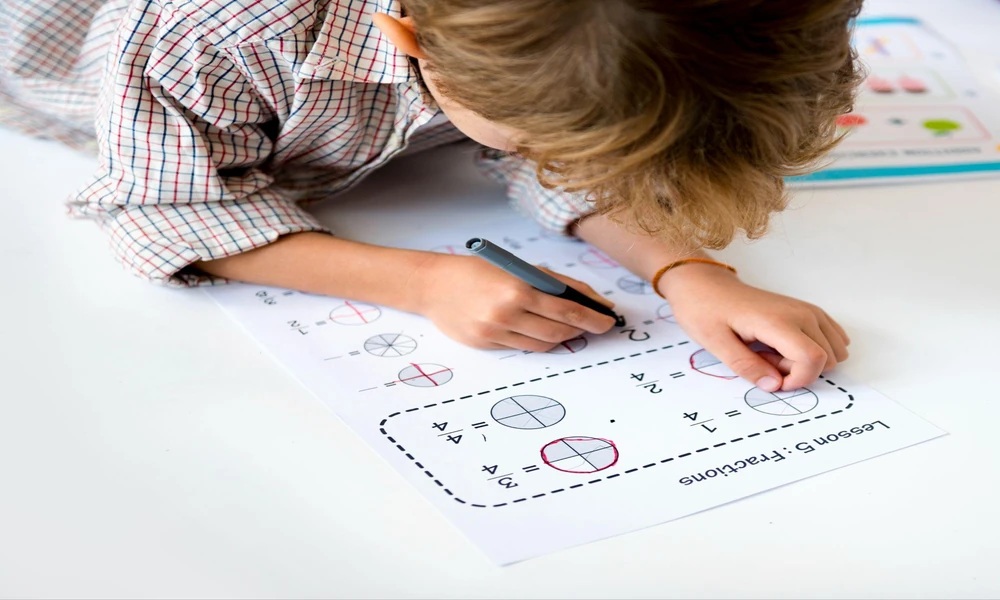
Image Recommendation: A child’s hand moving from counting physical blocks to writing a ratio equation on paper, side by side.
A Primary 2 student solving an apple-sharing problem can usually picture exactly what’s happening: someone hands over some apples, and someone has fewer left. A Primary 5 student working through a ratio problem is dealing with something that was never physically countable in the first place, a relationship between quantities that exists only on paper. Both are technically “math questions.” The actual thinking required to solve them is genuinely different.
Two Questions That Look Similar and Aren’t
Placed side by side, the shift in what’s actually being asked becomes easy to see:
| A Typical Lower Primary Question | A Typical Upper Primary Question |
| “Ali has 8 apples. He gives 3 to Ben. How many apples does Ali have left?” | “Ali and Ben share some apples in the ratio 3:5. If Ben has 10 more apples than Ali, how many apples do they have in total?” |
| Solved by direct subtraction, matching numbers to a visible, countable scenario. | Requires setting up a ratio relationship first, an abstract structure with no objects to physically count. |
The lower primary question can be solved by picturing the scenario directly. The upper primary question requires building an abstract structure first, the ratio itself, before any actual arithmetic even begins. That extra step, translating a written scenario into an abstract relationship, is really the whole difficulty, not the arithmetic that follows it.
What Lower Primary Math Is Actually Training
The early primary years focus on building genuine number sense, a solid, intuitive feel for how quantities behave, grounded in scenarios a child can picture or physically act out. This isn’t a lesser or simpler stage of the same skill; it’s the necessary foundation that abstract reasoning will eventually be built on top of. A child who genuinely understands why subtraction works, rather than simply memorising the steps, is far better positioned for what comes later.
Why This Foundation Deserves Careful, Patient Attention
Rushing through the concrete stage to get to more advanced content sooner tends to backfire once abstraction actually enters the picture, since a shaky intuitive foundation makes the later abstract leap considerably harder to manage. Thoughtful primary math tuition in Singapore takes this foundational stage seriously in its own right, rather than treating it as a quick formality on the way to the content that supposedly matters more.
What Changes the Moment Abstraction Enters the Picture
Somewhere around Primary 4 or 5, questions start requiring a student to work with relationships that can’t be physically pointed to: ratios, fractions of unknown wholes, multi-step word problems where the underlying structure has to be inferred before any calculation can start. This isn’t simply harder arithmetic layered onto the same kind of thinking. It’s a genuinely different cognitive task, translating language into abstract structure, that concrete-stage learning alone doesn’t automatically prepare a student for.
Why Upper Primary Tutoring Needs to Actively Bridge That Gap
Helping a student make this specific leap, from picturing a scenario to representing it abstractly, requires deliberate practice with exactly that translation step, not just more word problems attempted the same way as before. A skilled primary maths tutor at this stage focuses explicitly on that translation skill, helping a student build the specific habit of turning an unfamiliar scenario into a workable abstract structure before ever reaching for a calculation.
Why Parents Often Miss This Shift Entirely
From the outside, primary math tends to look like one continuous subject: numbers, more numbers, slightly bigger numbers. The genuine shift in the kind of thinking required rarely gets named explicitly, which means a struggling upper primary student is often assumed to simply need more practice on the same kind of problems, when the real gap is actually in the translation step that concrete-stage practice never specifically targeted.
Solving for apples and solving for ratios were never really the same skill wearing different numbers. One asks a child to picture a scenario. The other asks them to build one that was never physically there to begin with. Recognising that distinction tends to matter more for a struggling upper primary student than simply assigning another stack of practice questions.
Not sure whether the gap is arithmetic or abstraction? Contact CalibreMath and find out which one actually needs attention.




Comments are closed.