
Important Insights
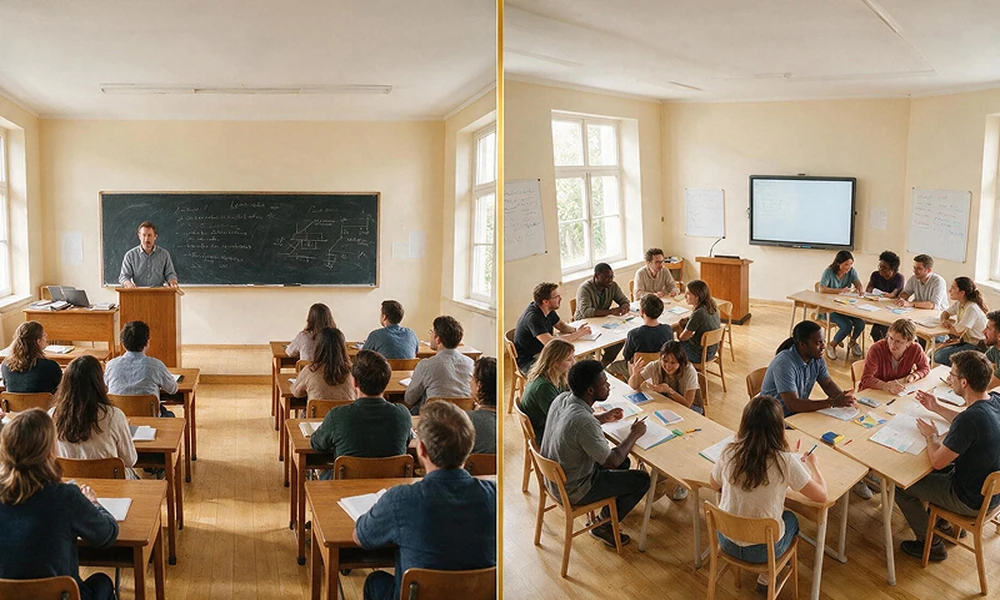
- The IB focuses on inquiry-based learning rather than the traditional lecture-and-memorisation model.
- Assessment in the IB is continuous and multifaceted, whereas traditional pathways often rely on final exams.
- The IB curriculum is inherently interdisciplinary, encouraging students to find links between different subjects.
- Traditional pathways often focus on local standards, while the IB is designed for global mobility and recognition.
Introduction
Parents comparing educational pathways often look at the International Baccalaureate (IB) alongside A-Levels or other national curricula. Both can provide strong academic preparation, but they organise learning, assessment, and student development differently.
Traditional pathways often place greater emphasis on subject mastery and examination performance. By comparison, IB curriculum schools combine academic content with inquiry, independent research, interdisciplinary learning, and international perspectives. Understanding these differences can help parents assessing IB schools in Singapore decide which environment better suits their child’s learning habits and future plans.
1. How Does the IB Approach Classroom Learning Differ From Traditional Education?
Traditional classrooms commonly follow a content-led approach in which teachers introduce subject knowledge, explain key concepts, and prepare students to demonstrate mastery through structured assessments. This format can work particularly well for students who prefer clear syllabus boundaries and direct instruction.
IB curriculum schools place greater emphasis on inquiry-based learning. Teachers still provide guidance and subject expertise, but students take a more active role by questioning ideas, conducting research, discussing different interpretations, and applying knowledge to unfamiliar situations.
The difference becomes clearer when comparing how students may approach the same topic:
| Traditional Pathway | IB Approach |
| Focuses strongly on mastering prescribed content | Combines content knowledge with inquiry |
| Often follows structured teacher-led instruction | Encourages guided independent investigation |
| Prioritises correct application of learned concepts | Requires students to explain and evaluate ideas |
| Usually works within defined subject requirements | Frequently connects learning with broader questions |
Neither approach removes academic rigour. The distinction lies mainly in how students engage with the material and how independently they are expected to explore it.
2. How Are Students Assessed in IB Schools?
Assessment represents another major difference between the two pathways. Traditional systems often give substantial weight to final or national examinations. Students may spend significant portions of the academic year preparing to demonstrate their knowledge during a relatively limited examination period.
IB schools in Singapore also use examinations, particularly at Diploma Programme level, but assessment does not rely exclusively on final papers. Students may complete essays, projects, presentations, investigations, oral work, and other internally assessed components throughout their course.
This approach requires students to manage several forms of academic work at the same time. Instead of concentrating only on examination technique, they must develop research, writing, presentation, organisation, and time-management skills.
Continuous assessment does not necessarily make the IB easier or less demanding. It distributes academic requirements across different tasks, which may suit students who perform consistently across the year. Students who strongly prefer examination-based learning may find a more traditional structure easier to navigate.
3. How Does the IB Connect Different School Subjects?
Traditional curricula often teach subjects as clearly separated disciplines. Students may study mathematics, science, literature, and humanities independently, with each course following its own syllabus and assessment objectives.
IB curriculum schools encourage students to recognise relationships between disciplines. This does not mean subjects lose their individual academic requirements. Instead, students learn to apply ideas from one area when considering questions in another.
For example, interdisciplinary learning can encourage students to:
- Consider ethical questions alongside scientific developments.
- Use mathematical reasoning to interpret social or environmental data.
- Connect historical events with literature, politics, or cultural change.
- Examine global issues from several academic perspectives.
This approach can benefit students who enjoy exploring how ideas connect rather than treating each subject as an isolated body of knowledge. It also reflects the type of thinking often required in university study, where complex issues rarely belong to only one discipline.
4. How Do IB Schools Develop an International Perspective?
National education systems usually reflect the academic standards, cultural expectations, and examination requirements of a particular country. This provides students with a clear educational framework and can create strong preparation for progression within that national system.
The IB follows an international framework used by schools across different countries. As a result, IB schools in Singapore often attract families who expect international mobility or want their children to prepare for universities in several possible destinations.
International-mindedness also forms part of the learning experience. Students encounter different cultural viewpoints, study languages, and consider how issues affect communities beyond their immediate environment.
The practical differences can include:
Curriculum orientation: National pathways usually align closely with domestic education standards, while the IB follows an internationally recognised framework.
University planning: Students considering universities overseas may value a qualification that institutions across multiple countries routinely recognise.
Cultural exposure: International school environments can introduce students to classmates, teachers, and perspectives from different backgrounds.
Mobility: Families relocating between countries may find an international curriculum provides greater continuity between schools.
Parents should still examine the individual school rather than choosing solely because it offers the IB. Teaching quality, subject availability, student support, school culture, and university guidance can differ considerably between institutions.
Frequently Asked Questions
Is the IB More Difficult Than Traditional School Pathways?
The IB can be demanding because students manage examinations alongside coursework, projects, research, and other academic requirements. However, difficulty depends on the student’s strengths. Some learners prefer continuous assessment and independent work, while others perform better within more examination-focused systems.
Is the IB Suitable for Students Who Prefer Structured Learning?
Yes, although students should be comfortable taking increasing responsibility for their learning. IB programmes still follow defined academic requirements, but they expect students to investigate ideas, manage projects, and contribute actively during lessons.
Do IB Students Still Take Final Examinations?
Yes. Final examinations remain an important component of the IB Diploma Programme. However, students also complete internally assessed work, which contributes to their overall performance.
Is the IB Better for Students Planning to Study Overseas?
It can be a suitable option because universities across many countries recognise the IB. Families should still check the specific entry requirements of the universities and degree programmes their child may eventually consider.
What Should Parents Compare Between IB Schools in Singapore?
Parents should review the programmes offered, subject choices, class environment, learning support, extracurricular opportunities, university counselling, teacher experience, and the school’s overall approach to student wellbeing.
Contact ISS International School to learn how its IB programmes approach inquiry-based learning, interdisciplinary study, and international education for students in Singapore.

Comments are closed.